Wednesday, 18 July 2018

ACCESS TO SAFE WATER, THE AGONY OF RURAL COMMUNITIES IN NIGERIA


By Temitope Musowo           Women washing by a stream called  Odo-Iyaonirobo
According to World Health Organization (WHO), safe water means consistent access to and adequate supply of clean water suitable for drinking, bathing, cooking and cleaning. This must be from a source less than 1kilometer (62miles) away and at least 20 litres (5.28 gallons) per person per day.

Going by the above definition, safe water is out of reach of most people living in the rural communities, particularly in Nigeria.
      
Talking about importance of water, the late afro-music legend, Fela Anikulapo Kuti described water as an indispensable essential of life that has no enemy.

One of the most crucial natural resources which can make a meaningful contribution to the socio-economic development of rural communities is water. It is widely used for various reasons or purposes ranging from household chores to agricultural purposes. 

However, to most rural dwellers, safe water is a luxury meant for the people in the cities, but sadly enough, despite the rate of rural-urban migration in recent time, more than half population of the people in sub-Saharan Africa still live in rural communities where living standard is acutely poor and primitive.

Nigeria as a case study

This is particularly correct about Nigeria as a county, in the sense that, apart from the 36 state headquarters in Nigeria, Abuja the federal capital, and probably the 774 Local Government headquarters, life in other parts which formed the larger percentage of the entire country is characterized with pervasive rural poverty.

So worrisome enough, the government seem not to be in touch with this harsh reality.  These people are completely cut off from governance.

There is hardly government presence in these rural communities, perhaps the only time they are remembered is during electioneering campaign, after that, they cease to exist in government developmental agenda.

Pervasive rural poverty

The ordeal of the rural communities sound painfully familiar to me as I was born in such environment, majority of the villages in Nigeria are where people still trek several miles to the stream, which is  their major source of water,  places where there is no communication at all, they are completely cut off from the national grid.

These communities are where children trek some distance to school every morning and would get completely fagged off and too tired to listen to teachers in class, worst still, many of them would still have to walk several kilometres after school hours to meet their parents on the farm, where they would have their lunch.

 In this day and age, these people have not advanced beyond the use of firewood for their cooking, like in the Stone Age, the use of grinding stone to grind pepper is still a common practice among them. There is just no sophistry to dress up this naked fact, this is the real situation in our rural communities.

Politics apart, this is still the Nigeria of 21st century, and I dare anyone who sees Nigeria in the light of Lagos, Abuja, Port- Harcourt and other cities to follow me on a rural excursion to see the real Nigeria.  And the question is, what percentage of the entire country call Nigeria are these urban centres?

Water scarcity and the Mamu community example

The condition of people of Mamu community best describe this sorry state of rural life, Mamu, a community in Ijebu-North Local Government Area of Ogun State, located between the boundary of Oyo and Ogun, less than 20 kilometres to Ago-Iwoye ,with an average population of  3000 inhabitants.

People of this community are predominantly peasant farmers and petty traders, Mamu is notable for its market which is a point of convergence for traders across Ogun state and beyond, every five days, a good chunk of the local government revenue comes from this market, yet, the community has not been fortunate to enjoy government attention, much of the amenities that make life worth living in this century still elude them.

                                              Children fetching water from a well
Visiting the village, in this day and age, as important as water is to human existence, the first observation anyone would make is water scarcity, more vulnerable are the children and women who are seen carrying buckets in search of water to meet daily household needs.      
    
                                                                children coming from the stream some kilometers away from home                                                                         
A major cause of water scarcity in Mamu is the government’s failure to redress the colonial imbalances which resulted in rural areas deliberately being side lined as far as water development projects are concerned. The centralisation of power since independence has resulted in bias towards improvement of water availability in urban areas and commercial farms at the expense of rural areas.

Major sources of water in Mamu community

Apart from one or two unprotected wells dug by people for provision of water for their households, the community major source of water are streams and a small river, quite unfortunate, most of these water sources are far from being clean and unsafe for domestic use, many of the streams visited takes their sources from another stream somewhere that flows down to form another body of water somewhere.


Although, there are indications that efforts have been made in the past by government to provide water for the community through borehole, even pipe- borne- water, as relics of broken plastic pipes, rusted tanks and water points were found, yet, scarcity of water remain the current reality of the community.

Tracing the sources of these streams, findings showed one stream called Odo- Idiarika which flows down to form another body of water called Odo-Apata, where people do all manner of washing and the dirty water from washing flows back into the stream, which is not far from another body of water called Odo-Yemoja, that flows down to Odo-Epa, and from there to Odo-Iyaonirobo, all these streams are along the same area.Other stream in other part of the town include; Odo-OlopaOdo-Gbirigbiri and so on.

Mrs Tumininun nee Osikoya from Yemoja river 


According to a man called Kunle Alagaode, who lives along the road to a popular river, called Odo-Idiarika, he explained the community's effort in ensuring cleanliness and water availability all year round, he said, " Odo-Idiarika is a major river in this town, people come from even the extreme part of the community to Idiarika , ( the river is named after the street) to come and fetch water, Oloritun (head of the street) is always in charge of the river.

      A water bearer fetching from one of the  streams     
During the raining season, the rules guiding the river are a bit relaxed, but during the dry season when most streams must have dried up, all attention shift to Odo-Idiarika, but Oloritun will open the river only around 6am, close it by 12 noon and only reopen it around 4 pm again and close it at 7 pm," .

When asked what is used to close a body of water opened and not fenced, he said they would tie palm fronts round the river and nobody dare go there after this is done.
                      
Ensuring cleanliness of the water
As regard cleanliness, he said part of the regulations are that; you put off your slippers/shoes some distance from the river, you do not come to the river with chewing stick or chewing gum in your mouth, you are not allowed to deep your bucket into the river to fetch water, you must use a small clean bowl to fetch into your bucket, nobody is allowed to do any form of washing around the river, if you brought a rag to carry your bucket, you do not take the rag close to the river, you cannot place your legs on the pavement built at the heart of the river, these among other are the rule to ensure cleanliness according to Mr Kunle.

Rules enforcement
Talking of enforcement of these rules, he said, the Oloritun and other elders on the street are always by the river to enforce disciplines, if you flout any of these rules, some people's bucket would be seized, some will be beaten with cane, some would have their bucket broken and asked not to come to the river again if they have been found to be impervious to correction.
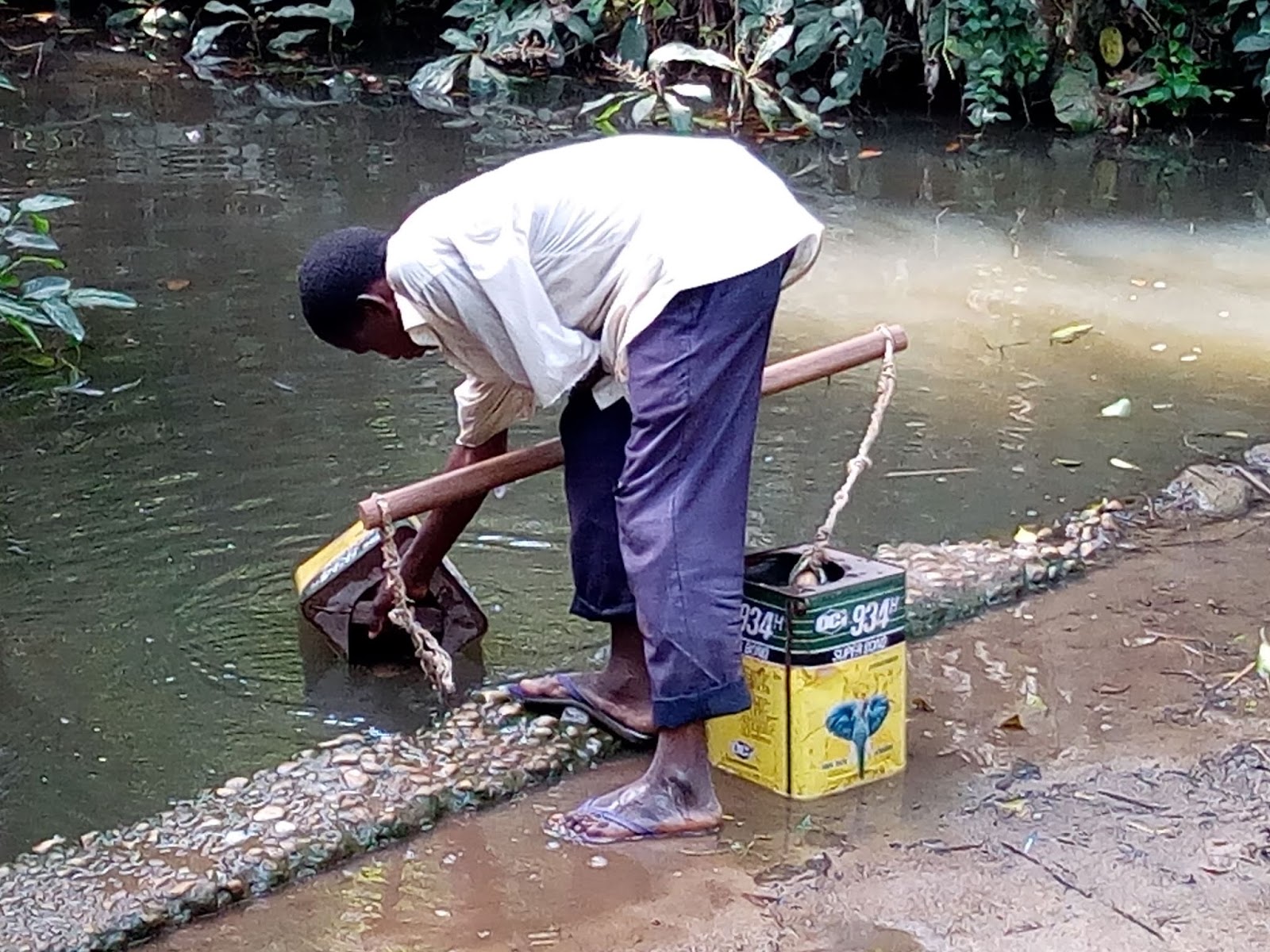
                A water bearer fetching from the river (Odo-idiarika)
When we visited the river, things have changed as people were seen flouting those rules, but Mr Kunle explained, "the reason is that there is no one to keep people in check anymore, most of those elders are now dead, others are too old to do all that now, I'm the one (Mr Kunle) who when I see people flouting those rules sometimes rebuke them, but what much can I do?.

Moreover, things have changed now, the kind of respect we accorded elders then no longer exist, more so, we easily believed those myths then, for instance, we were told that if you catch fish from this river and boil the fish from now till tomorrow it will remain raw, if you do anything untoward to the river, the goddess of water will be annoyed with you, all those myths are today being questioned by the younger generation’’, he lamented.

Vulnerability of women and children
In all these, children and women are always more vulnerable, they are at the centre of it all, grappling with the direct impact of this life bellow common standard of living.


A little survey conducted among  the  pupils in primary  5 and 6 of Wesley Primary School, Ipinle, Mamu revealed the negative toll this is having on their education, health and general wellbeing, many of who perpetually come late to school because they have to fetch water before coming to school in the morning, most times missing out on the first 2 periods in the morning, ‘’ I have to fetch water to fill at least 3 drums every morning before coming to school’’, one of the pupils said, when asked what they use that volume of water for everyday, he said ,’’we use it for our grinding machine and other commercial use’’.
                                                 
Another one among the children confessed that sometime she may not take her bath before coming to school if there is no water at home, some of the pupils also owned up to the fact that they pile up their dirty clothes for weeks to save water.
When they were asked if anyone of them have been infected with water borne disease before due to contaminated water, majority of them confirmed this.   

More worrisome is the fact that many of these pupils are sent out by their teachers to look for water for the school use during school hours and for the teacher’s domestic use after the school hours.
       Pupils of St Charles Pry Sch Mamu  fetching water during school hours
The effect on their socio-economic lives

Women bear the heaviest burden when there is no safe water and sanitation. In most places that lack these resources, women and children are responsible for retrieving water for their families, often spending several hours each day travelling and waiting at a water point. This often puts them at the risk of assault and injury.   
                                                    women working at a local palm oil mill

Some women who spoke with us lamented the impact of water scarcity on their businesses. According to Mrs Akomolafe, who prepares corn pap for sale, she complained about how much she spends on buying water from water bearers who sell water in gallons, ‘’you know the process of preparing pap involves a lot of water, you soak the corn in water for some days, you wash before grinding it and sieving it too you will need water not to talk of the final process of turning it on fire which also involves water, we buy 200-litres gallon of water for hundred naira, how much gain are we making?. The stories of other women working in the local oil mill were not different as they equally lamented the cost of getting water to do their work.
                       
Effect on their Health
WHO report has it that Over 40 billion productive hours is lost each year to fetching water in sub-Saharan Africa. About half of the developing world’s hospital beds are occupied by people with water- related illness.  
The health of the community members is largely dependent on water and sanitation, improved water and sanitation would result to reduction in cases of diarrhoea and other water-borne diseases. Communities are vulnerable to health and sanitation risks due to the unavailability of clean water.

Mrs Akomolafe  wrapping her pap with leaves  

There is a high risk of communities being exposed to water borne diseases, this cannot but happen in a community where people scoop water from holes in dried-out rivers, unprotected wells, and rainwater ponds, as in Mamu community where water is susceptible to contamination, this will definitely lead to diseases and ailments.

A visit to the only private Maternity home in the community ( Marian Maternity Home, Idi-Arika, Mamu) and a Primary Health Centre situated in an area called Ipinle in the community lend credence to this fact, many patients were seen receiving treatment from water related ailments.

Effect on children’s Education
Studies have shown that in the world’s poorest countries millions of children are unable to attend schools due to household chores and responsibilities for collecting water, and health related problem caused by unclean water also cause student absenteeism.
According to a UNICEF report, an estimated 443 million school days are lost each year from water-related illness. In many cases, children are too sick with diarrhea and other water-borne diseases like typhoid, cholera, or dysentery to go to school or must care for sick family members instead of going to class.  
The response from the pupils of Wesley Pry School who were interviewed as sample frame corroborate the above fact, this is equally true of the pupils in the two other primary schools in the community namely; St Peter Anglican Primary School, St Charles Catholic Primary School Mamu.
Agricultulture
Farming productivity has declined over the years in Mamu due to water scarcity. Many of the people in this village are subsistence farmers who only grow crops for the benefit of their families.  This has had a detrimental effect on the livelihoods of majority of the households who do not have other source of income apart from farming. These are the words of lamentation coming from many farmers that were interviewed in the community.
           
Government failure to provide water for the community
After the demise of the Rtd. Major Jimoh Onawaye, the late Baale of Mamu, who passed on some years back, Mr Adewale Miliki, a retired headmaster has been holding sway as the head of the community.
Mr Adewale has this to say about the neglect and abandonment being suffered by this community, ‘’Mamu is has been suffering neglect in the hand of successive governments of Ogun State for years, reason being that everything that is supposed to come here is always being hijacked by Ago-Iwoye, because Mamu is seen as a village under Ago-Iwoye, meanwhile, this town generate more IGR  than most towns in Ogun state because there is no where within the state where they don’t  come and do business in Mamu market, apart from the market, this town produces more cocoa and cola nut more than most towns in Ogun state, it was this huge production of cocoa that led Queen Elizabeth to visit Mamu when she visited Nigeria in 1956.

Even politically we are always short-changed here, instead of appointing a councillorship candidate from Mamu, they will go and appoint from Ago-Iwoye, meanwhile, majority of the votes would come from here, Only God will remember us in this community, we have been neglected for long’’, he lamented.
As regard the issue of water, he said, ‘’during the time of former governor Olusegun Oshoba he tried to give us pipe-born water but I am not sure it worked for a month when everything packed up, after that, other government also

                                                                  The community head,Mr Adewale Miliki
tried but to no avail, you can see the water tank by the   present House of Rep member but these cannot even serve one quarter of the town, how many litre is the tank you see. May god help us in Mamu my son’’, Mr Adewale concluded.

It remain to be seen if the government of Ogun State will open the book of remembrance concerning Mamu community soon, however, government attention may continue to elude them in this community given the fact that they don’t really have a substantive community head who can be their mouth piece for now as comments from some members of the community shows Mr Adewale Miliki is a self appointed leader who is not even recognised as the community head in some quarters.

Wednesday, 20 June 2018

Move against domestic violence, Ambode’s wife charges women


By Temitope Musowo
Wife of the governor of Lagos State, Bolanle Ambode, has urged women in the state, to pay due attention to their health and speak out against social vices like domestic violence, child abuse, rape and teenage pregnancy.

She gave the charge at a women’s forum organised by her, at the Police College, GRA, Ikeja, to address issues of women’s health and recurring social vices in the society.


Mrs Ambode noted that good health was a prerequisite for every other thing, including good attention to children and family, business and even political activities, stressing that without good health, nothing meaningful could be achieved.

According to her, "health is wealth’ they say, because good health is the gate way to everything. To have good health, we need to take care of our body, mind and soul.


"It is when we have good health that we can run around for business, take care of our homes, our children or engage in political activities. When we have sound health, we can better attend to all issues and concerns." 

The governor’s wife who condemned the high rate of prevalence of social nuisance in the society, told the women to boldly voice out their discontent against domestic violence, child abuse, rape and teenage pregnancy.


She described the attitude as barbaric and unacceptable in civilized climes, charging women to seek to know their rights under the law, to shun silence and be vocal voices for their own cause.

Mrs Ambode said: "Importantly too, we would be examining the rights of women under the law, in the face of persistent social problems. When we know our rights, we can speak better and act better, to protect ourselves if and when those circumstances arise." 


She reminded the women of their natural role as mothers and coordinators of the family unit, which according to her, imposed on them the salient responsibility of bringing up their children in the most decent way for a decent and moral society.

Speaking at the event, Deputy Governor of Lagos State, Dr.  Oluranti Adebule, said the forum provided a platform where women could engage in sustainable discourse, to increase their knowledge and enhance their awareness, on health and well-being as participants.

Adebule said it was unfortunate that 23 years after countries signed pledges in 1995 Beijing Declaration and Platform of  Action, women still faced many health-cum-social problems, saying that there was need for recommitment to address them. 

She urged Lagos women to embrace sustainable advocacy and take conscious action on matters concerning their health and how they were treated by the society at large.

"We should no longer be stereotyped into silence but become vocal advocates for improved health delivery system and social justice for women in Lagos State and the country.

"As critical stakeholders, our role must be focused on investing and increasing access of more girls and women to good health, quality education; ensuring that laws that respect and ensure the rights of women are enforced and help create gender-posture media messages that support women and girls in distress," she said.

Adebule, however, appealled to all women to join hands with the government in the battle against dogmas inimical to healthy lifestyle, social malaise of domestic violence, child abuse, rape and teenage pregnancy.

Speaking on the topic: "Be the Voice against Child Abuse and Teenage Pregnancy, "Mrs Modupeola Adebambo of the Ministry of Youth and Social Development, submitted that children who were sexually abused, tended to be sexually active thus exposed to teenage pregnancy, sexually transmitted diseases and alcoholic addiction, among others.

She appealed to parents not to abuse their children in whatever form, adding that parents should teach their children sex education to make them aware of the danger inherent in sexual abuse.

Director, Office of Public Defender, OPD,  Olayinka Adeyemi, who spoke on domestic violence and rape, urged women to speak out against domestic violence and report such cases to the OPD for immediate legal action.

While the duo of Mrs. Rashidat Hassan and Mrs. Akintunde Ibironke of the Ministry of Health, advised the women to go for regular checks, for early detection of ailments.

The programme came in two sessions, with the first session dedicated to general health screening, cancer screening and distribution of 500 free eye glasses while the second session was devoted to health talks and topics on issues of social vices.

All dignitaries at the event took a stand against domestic violence, child abuse, rape and teenage pregnancy, and encouraged healthy living.

The programme saw over 3000 women in attendance.

Thursday, 14 June 2018

Women Empowerment: Ondo First Lady Seeks African Development Bank's Collaboration

By Temitope Musowo
In her deep sense of commitment to women affairs and development, Wife of Ondo State Governor has called for African Development Bank's (AfDB) collaboration in the area of women empowerment and social development in the State.
Mrs Akeredolu made this call during a technical session with the visiting AfDB group management team led by its Senior Director Mr Ebirima Faal at the Ondo State Executive Council Chamber, Akure.
Mrs Akeredolu welcomed AfDB group to Ondo State and wished them a happy stay during the period of their stay in Ondo State.
The Sunshine State First Lady recounted some of the Landmark Achievements of the office of the Wife of the Governor within one year in office to include;
ICT training for 105 girls from across Ondo State, where all the participants went home with a tablet.
Solar Renewable Energy training for over 200 Ondo State girls and beyond,
Skill Acquisition training for over 1000 women in 5 LGA's in her FOWOSO women empowerment program, where a hundred women and girls smiled home with a laptop.
Others include:
Accelerated birth registration
Massive Breast Cancer Awareness in Nigeria etc.

Mrs Akeredolu stressed that all these achievements were accomplished in the midst of huge debt inherited by their Administration on assumption of office and called for AfDB's collaboration towards giving Ondo women and children the much desired dividends of democracy in the area of qualitative Health Care delivery, Maternal and child mortality reduction, Poverty alleviation, Gender parity etc.
Contributing the Senior Director of the AfDB Nigeria Country Office, Mr Ebirima Faal commended Mrs Akeredolu for what he described as a "passionate work" she is doing in Ondo State, stressing that it is in line with what the bank is committed to.
Mr Faal further pledge the support of AfDB to the programs of the office of the Wife of the Governor.
In her remarks, one of the management team members of AfDB Linda Amadi, commended the First Lady in her community oriented programs and projects which she said grantees sustainability and acknowledged that it is also part of the banks interest and what the are concerned with.
She further revealed that the bank has a job for youths in Africa initiative which is hoped to generate 25million jobs for African youths in the next 10years.
She assured Mrs Akeredolu of women inclusion and that the bank is keen in incorporating gender in all its activities and programs.

Wednesday, 13 June 2018

POLLUTION: N.G.O CANVASSES TOTAL BAN ON PLASTIC USE


Dapo Thomas

A Lagos based Non Governmental Organisation (NGO) with focus on the 17 Sustainable Development Goals (SDGs),Blossom Africa Initiative is canvassing for a total ban on plastic use in Lagos as a solution to plastic pollution and its effect on the environment. 

Blossom Africa Initiative which in line with the theme of this  year's World Environment Day, "Beat Plastic Pollution", today took  the campaign to reduce plastic waste to shopping malls in Lagos.The organisation in their branded T-shirt stormed Ikeja shopping mall, educating consumers about the need to reduce plastic waste which they said is harming our environment, distributing flyers to shoppers.

The  NGO which last week joined the Lagos State Environmental Protection Agency (LASEPA), to celebrate the world environment day. said it is all out to create  awareness about the United Nations 17 Sustainable Development Goals (SDGs) and the role everyone has to play in the actualization. 


Speaking with journalists after the exercise, the President of the Organisation,Mr Temitope Musowo said the exercise was important to send signal to stakeholders that campaign about protection of our environment should not be a once- in- a -year affair. 

"Every year, we come together to celebrate World Environment Day and after the usual noise about protection the environment  it all ends there,we go back to business as usual,people still continue polluting our environment, this should not be a one off campaign,it should be a continuous exercise  until people get the message.

Do you you know how much harm plastic pollution is doing to our environment and marine life, if I have my way I will push for outright ban of plastic use in Lagos in particular ,especially  single use plastic,and this is why I said that,for instance, Lagos generate 16,000 metric tones of waste on daily basis,which means Lagos generate 1600 metric tones of plastic waste daily because findingings have shown that 10% of waste we generate is plastic",he said.

Mr Musowo further condemned what he described as single-use plastic which he said form 50% of the plastic we use,saying it takes an average of 500 years for plastic to decompose while we use our plastic bags for just an average of 12 minutes.

According to the President, one of the reasons we experience perennial flooding in Lagos is because of metric tones of plastic waste that find their ways into  the sewage system and providing breathing space for Mosquitoes, raising the risk of malaria transmission. 

" Do you know that every year, the world use 500 billion plastic bags,about 13 million tones of plastic leak into the ocean,do you know every year ,17 million barrels of oil is used to produce plastic bottle for our water and if we continue like this by year 2050,there will be more plastic than fish in the world's ocean ",he maintained. 

He called on everyoneto be part of the solution to plastic pollution by refusing what they cannot reuse, switching from single-use plastic to biodegradable products and improve waste collection through sorting,recycling and reprocessing while making environmental friendly choices.

Speaking further about the vision of the organisation, the President said,"we observed that one of the reasons no African country was able achieve the Millennium Development Goals (MDGs) was because of the low level of awareness among the populace,now we have another opportunity with the SDGs again,if you sample the opinion of people on the street you will discover many people are not even aware meanwhile, we all have a role to play the fulfilment. 

This need to champion this awareness campaign and advocacy gave birth to Blossom Africa Initiative,as you can see this is just one of our campaign as it has to do with Goal 7,13,14 and 15 ,talking about our environment now,subsequently, we are taking the SDGs campaign to schools to get the children involved for sustainable sake",he reiterated 

Tuesday, 22 May 2018

CDC TO RESPOND TO EBOLA OUTBREAK IN DEMOCRATIC REPUBLIC OF CONGO


Africa Centres for Disease Control and Prevention to deploy epidemiologists, laboratory experts, and anthropologist to respond to the Ebola outbreak in Democratc Republic of Congo

Urges long-term action to build resilient health systems locally and national public health systems to pick up events rapidly

Kinshasa/ Bandaka/Bikoro, 20 May 2018 - The Africa Centres for Disease Control and Prevention (Africa CDC) is deploying 25 epidemiologists, laboratory experts, and anthropologists to support the government of the Democratic Republic of Congo’s (DRC)  efforts to control the recent Ebola virus outbreat in Mbandaka and Bikoro. Following the announcement on 8 May 2018 of the Ebola outbreak by the government of DRC, the Africa CDC deployed an assessment mission within 48 hours and activated its Emergency Operational Centre to link, scan and monitor the situation.

“The global community needs to respond to this outbreak as a crisis and not as an emergency, by quickly deploying public health assets to the affected areas expiditiously”. I want to applaud the Minister of Health of the DRC for his exemplary leadership in managing this current outbreak so far. “All our efforts should be geared towards supporting his leadrship” said Dr. John Nkengasong, the Director of the Africa CDC, upon his return this week, with a high level delegation, to the affected areas in Mbandaka and Bikoro.
The DRC government is working with partners to improve coordination mechanisms, enhance surveillance, laboratory confirmation, contact identification and follow-up, case management, infection prevention and control, safe and dignified burials, social mobilisation and community engagement, logistics, risk communication, vaccination, partner engagement, research and resource mobilisation.


During the Africa CDC team’s visits they assisted the Ministry of Health, together with other partners,  to develop three strategies: a) surveillance and contact tracing, b) Defining the various health areas affected, and c) laboratory testing and network. The Africa CDC will provide up to USD 2 million to support Africa CDC interventions. Due to the remote nature of the Equateur Province, it is expected that more efforts will need to be put in supply chain issues to ensure that essential items needed are delivered swiftly. Last week the African Union Peace and Security Council was briefed on the situation and will continue to receive reports.  Under Article 6(f) relating to its mandate with regard to humanitarian action and disaster management the Council can authorise deployment of military and civilian missions and assets to tackle emergency situations as it did in August 2014 in the Ebola outbreak in the West Africa sub-region. This outbreak is the 9th outbreak of the Ebola virus disease over the last 4 decades in the country. The affected health area of Bikoro covers 1 075 km and has a population of 163 065 inhabitants. This huge population is supported by only 3 hospitals and 19 health centres, most of which have limited functionality. 

The risk of speard of the virus is high at national and regional levels due in part to the proximity of the epidemic focus to the Congo River which links with the capitals of the Republic of Congo and the Democratic Republic of Congo and the Central African Republic. As such, Africa CDC is coordinating with these countries to ensure that their surveillance systems are activated and information is shared in real time.

About the Africa CDC
The Africa CDC supports all African countries to improve surveillance, emergency response, and prevention of infectious diseases. This includes addressing outbreaks, man-made and natural disasters, and public health events of regional and international concern. It further seeks to build the capacity to reduce disease burden on the continent.
For further information contact

Mr. Tawanda Chisango I AIDS Watch Africa (AWA) Program Advocacy & Partnership Expert | Social Affairs | African Union Commission I E-mail: chisangot@africa-union.org  | Web www.au.int Iwww.aidswatchafrica.net 
Addis Ababa | Ethiopia


Urges long-term action to build resilient health systems locally and national public health systems to pick up events rapidly

Kinshasa/ Bandaka/Bikoro, 20 May 2018 - The Africa Centres for Disease Control and Prevention (Africa CDC) is deploying 25 epidemiologists, laboratory experts, and anthropologists to support the government of the Democratic Republic of Congo’s (DRC)  efforts to control the recent Ebola virus outbreak in Mbandaka and Bikoro. Following the announcement on 8 May 2018 of the Ebola outbreak by the government of DRC, the Africa CDC deployed an assessment mission within 48 hours and activated its Emergency Operational Centre to link, scan and monitor the situation.

“The global community needs to respond to this outbreak as a crisis and not as an emergency, by quickly deploying public health assets to the affected areas expeditiously”. I want to applaud the Minister of Health of the DRC for his exemplary leadership in managing this current outbreak so far. “All our efforts should be geared towards supporting his leadership” said Dr. John Nkengasong, the Director of the Africa CDC, upon his return this week, with a high level delegation, to the affected areas in Mbandaka and Bikoro.

The DRC government is working with partners to improve coordination mechanisms, enhance surveillance, laboratory confirmation, contact identification and follow-up, case management, infection prevention and control, safe and dignified burials, social mobilisation and community engagement, logistics, risk communication, vaccination, partner engagement, research and resource mobilisation.

During the Africa CDC team’s visits they assisted the Ministry of Health, together with other partners,  to develop three strategies: a) surveillance and contact tracing, b) Defining the various health areas affected, and c) laboratory testing and network. The Africa CDC will provide up to USD 2 million to support Africa CDC interventions. Due to the remote nature of the Equateur Province, it is expected that more efforts will need to be put in supply chain issues to ensure that essential items needed are delivered swiftly. Last week the African Union Peace and Security Council was briefed on the situation and will continue to receive reports.  Under Article 6(f) relating to its mandate with regard to humanitarian action and disaster management the Council can authorise deployment of military and civilian missions and assets to tackle emergency situations as it did in August 2014 in the Ebola outbreak in the West Africa sub-region. This outbreak is the 9th outbreak of the Ebola virus disease over the last 4 decades in the country. The affected health area of Bikoro covers 1 075 km and has a population of 163 065 inhabitants. This huge population is supported by only 3 hospitals and 19 health centres, most of which have limited functionality. 

The risk of spread of the virus is high at national and regional levels due in part to the proximity of the epidemic focus to the Congo River which links with the capitals of the Republic of Congo and the Democratic Republic of Congo and the Central African Republic. As such, Africa CDC is coordinating with these countries to ensure that their surveillance systems are activated and information is shared in real time.

About the Africa CDC
The Africa CDC supports all African countries to improve surveillance, emergency response, and prevention of infectious diseases. This includes addressing outbreaks, man-made and natural disasters, and public health events of regional and international concern. It further seeks to build the capacity to reduce disease burden on the continent.
For further information contact

Mr. Tawanda Chisango I AIDS Watch Africa (AWA) Program Advocacy & Partnership Expert | Social Affairs | African Union Commission I E-mail: chisangot@africa-union.org  | Web www.au.int Iwww.aidswatchafrica.net 
Addis Ababa | Ethiopia


You are receiving this message because you are a member of the community Journalists working on health.
View this contribution on the web site
A reply to this message will be sent to all members of Journalists working on health.
Reply to sender | Unsubscribe