Monday, 23 March 2020

African Development Bank announces bold measures to curb coronavirus

AfDB NEWS & EVENTS

18-Mar-2020
The African Development Bank on Wednesday announced health and safety measures to help prevent the spread of the coronavirus in countries where it has a presence, including its headquarters in Abidjan. The measures include telecommuting, video conferencing in lieu of physical meetings, the suspension of visits to Bank buildings, and the cancelation of all travel, meetings, and conferences, until further notice.
Bank President Akinwumi Adesina made the announcements at a Bank-wide virtual Town Hall meeting from the institution’s headquarters in Abidjan. He stated that the measures were being taken in the best interest of public health and safety.
“My primary responsibility is to you, to make sure you are safe, to make sure your families are safe, to make sure you can function where you are under the best possible conditions health and security wise,” Adesina said. 
Adesina said all efforts are being made to ensure continuity of the Bank's operations including electronic documentation and approvals.
All Bank staff worked from home on Wednesday to test-run IT systems  
The Bank has already taken several other steps to counter an escalation of the virus, including a 14-day self-quarantine for employees returning from high-risk countries. 
Other multilateral institutions in Asia, Europe, and Latin America. have taken similar actions to prevent the spread of the virus.
Since the start of the COVID-19 outbreak in December 2019, the Bank has closely monitored the situation through its medical center, emergency management team, and its operational and executive crisis committees. Staff have regularly been provided with medical guidance and preventive measures are in place to protect staff and families from contamination by the virus.
A three-level COVID-19 response plan has also been developed to avert, manage and mitigate the effect of the pandemic on Bank’s staff and their families, while ensuring business continuity in the event of an escalation of the situation on the continent. 
“Please do not panic. Measures are being taken. The situation deserves that we change how we work and where we work from,” Adesina said.
The Bank's Board of Directors is reviewing the configuration and design of the Bank's statutory Annual Meetings originally scheduled for May 26-29, 2020 in Abidjan.
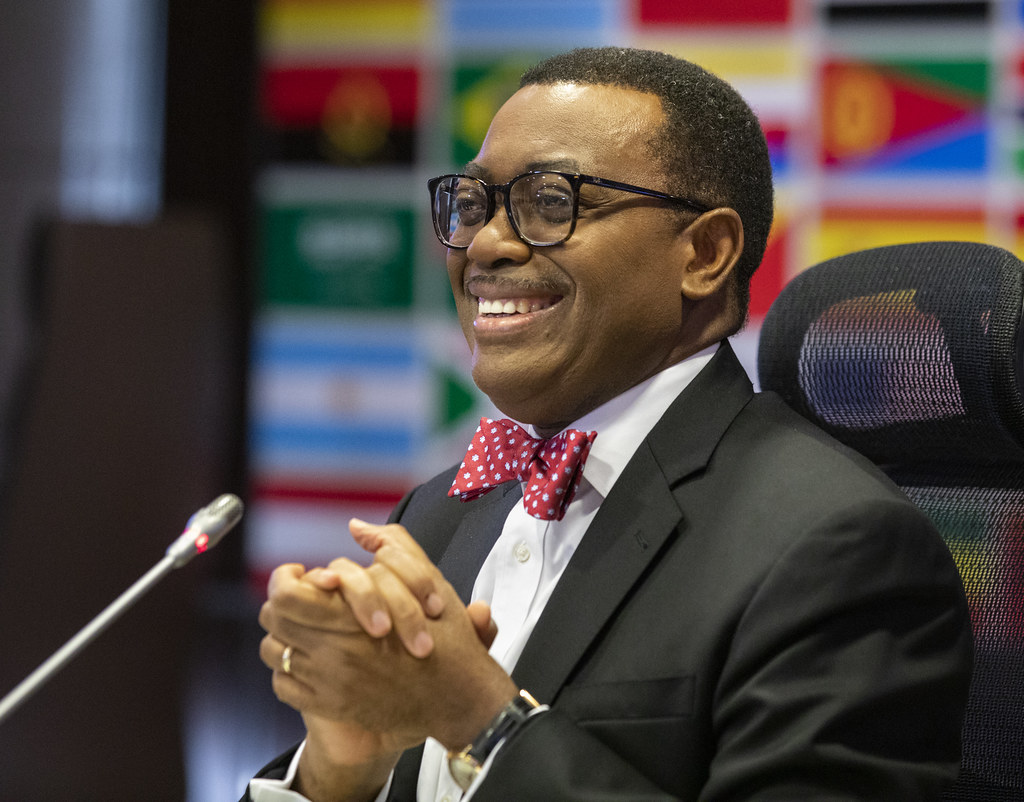
Virtual Town Hall Meeting  with the President Akinwumi A. Adesina

Botswana: African Development Bank supports economic diversification project through FAPA

AfDB NEWS & EVENTS

12-Mar-2020
An economic diversification project supported by the Africa Development Bank was launched in Botswana last month to strengthen the small stock, tourism and horticulture industries by improving businesses linkages particularly among small- and medium-sized enterprises (SMEs).
The Botswana Economic Diversification Project was launched on 6 February, 2020 in the capital Gaborone, with the aim of diversifying the southern African nation’s economy, which is heavily dependent on minerals, especially diamond exports.
Assistant Minister of Investment, Trade and Industry, Karabo Socraat Gare, underscored the need to diversify the economy and to improve the business climate in Botswana.
He hailed the African Development Bank for financing the project, which will, among other things, support a review of the country’s Private Sector Development Strategy.
“It cannot be more befitting that this programme is being funded by our own African Development Bank,” he said at the launch.
George Honde, Bank Lead Economist said that if successfully implemented, “support to the Botswana Economic Diversification Project will unlock a number of projects that will require both financial and technical support.”
He said the African Development Bank stood ready to work with the Government of Botswana and other private investors to provide support through both sovereign and non-sovereign lending.
The Botswana Economic Diversification Project is supported by the African Development Bank through a $1 million Fund for African Private Sector Assistance (FAPA) grant to be implemented over three years.
The project will back up to 100 high-growth SMEs selected from the small stock and horticulture sectors to enhance their production capacities, re-orient their business strategies and access wider markets for their products.
The overall goal of this technical assistance project is to assist Botswana’s government in its efforts to diversify the economy through increased competitiveness of SMEs, the engine of Africa’s economy. This will be achieved by supporting Business Botswana, a business association, to implement activities under the Botswana Private Sector Development Strategy (PSDS) which is the main framework for support to private sector development in Botswana.
More than a 100 people attended the launch in the capital Gaborone, including government officials, private sector leaders and development partners.
FAPA is a multi-donor thematic trust fund that provides grant funding for technical assistance and capacity building to support the implementation of the Bank’s Private Sector Development Strategy. The Governments of Japan and Austria, and the African Development Bank are active contributors to the fund, which to date has provided over $67 million to 83 projects in over 38 countries across Africa.
The FAPA portfolio includes regional and national projects aimed at improving the business environment, strengthening financial systems, building private sector infrastructure, promotion of trade and the development of micro-, small- and medium-sized enterprises.  Additional information on FAPA can be obtained from the following link https://www.afdb.org/en/topics-and-sectors/initiatives-partnerships/fund-for-african-private-sector-assistance or contact the FAPA_Secretariat@AFDB.ORG for specific requests.

Monday, 16 March 2020

Botswana: African Development Bank supports economic diversification project through FAPA

AfDB NEWS & EVENTS

12-Mar-2020
An economic diversification project supported by the Africa Development Bank was launched in Botswana last month to strengthen the small stock, tourism and horticulture industries by improving businesses linkages particularly among small- and medium-sized enterprises (SMEs).
The Botswana Economic Diversification Project was launched on 6 February, 2020 in the capital Gaborone, with the aim of diversifying the southern African nation’s economy, which is heavily dependent on minerals, especially diamond exports.
Assistant Minister of Investment, Trade and Industry, Karabo Socraat Gare, underscored the need to diversify the economy and to improve the business climate in Botswana.
He hailed the African Development Bank for financing the project, which will, among other things, support a review of the country’s Private Sector Development Strategy.
“It cannot be more befitting that this programme is being funded by our own African Development Bank,” he said at the launch.
George Honde, Bank Lead Economist said that if successfully implemented, “support to the Botswana Economic Diversification Project will unlock a number of projects that will require both financial and technical support.”
He said the African Development Bank stood ready to work with the Government of Botswana and other private investors to provide support through both sovereign and non-sovereign lending.
The Botswana Economic Diversification Project is supported by the African Development Bank through a $1 million Fund for African Private Sector Assistance (FAPA) grant to be implemented over three years.
The project will back up to 100 high-growth SMEs selected from the small stock and horticulture sectors to enhance their production capacities, re-orient their business strategies and access wider markets for their products.
The overall goal of this technical assistance project is to assist Botswana’s government in its efforts to diversify the economy through increased competitiveness of SMEs, the engine of Africa’s economy. This will be achieved by supporting Business Botswana, a business association, to implement activities under the Botswana Private Sector Development Strategy (PSDS) which is the main framework for support to private sector development in Botswana.
More than a 100 people attended the launch in the capital Gaborone, including government officials, private sector leaders and development partners.
FAPA is a multi-donor thematic trust fund that provides grant funding for technical assistance and capacity building to support the implementation of the Bank’s Private Sector Development Strategy. The Governments of Japan and Austria, and the African Development Bank are active contributors to the fund, which to date has provided over $67 million to 83 projects in over 38 countries across Africa.
The FAPA portfolio includes regional and national projects aimed at improving the business environment, strengthening financial systems, building private sector infrastructure, promotion of trade and the development of micro-, small- and medium-sized enterprises.  Additional information on FAPA can be obtained from the following link https://www.afdb.org/en/topics-and-sectors/initiatives-partnerships/fund-for-african-private-sector-assistance or contact the FAPA_Secretariat@AFDB.ORG for specific requests

The African Development Bank enters the capital of the investment fund Yeelen Financial Fund LP

AfDB NEWS & EVENTS

12-Mar-2020
The Board of Directors of the African Development Bank approved, Thursday, March 11 in Abidjan, a stake of 12 million euros in the capital of the Yeelen fund dedicated to the financial sector.
Yeelen Financial Fund LP is a 12-year investment fund domiciled in Mauritius and Lomé. It aims at a capitalization of 65 million euros in order to invest in the financial institutions of the eight countries of the West African Economic and Monetary Union (UEMOA). This fund will invest capital in banks, microfinance institutions (MFIs), financial technology companies (Fintechs) and insurance companies.
The aim is to help these institutions comply with regulatory requirements in terms of minimum capital and equity; to support their expansion by widening their reach to financially excluded populations and by developing credit and insurance products adapted to their conditions.
Through this investment, the African Development Bank intends to strengthen financial inclusion in the WAEMU zone, which remains one of the areas least well served by financial products such as micro-credits, and by insurance products such as insurance, micro and meso-insurance.
 “The Bank is delighted with a collaboration with Yeelen Capital promoted by Cauris Management with which it intervenes in the area through previous funds. We hope that this collaboration will increase deep inclusion and further stimulate the development of the area's private sector while improving the living conditions of the target populations, "said the director of the Bank's Financial Sector Development Department, Stefan Nalletamby.
"This fund will help strengthen level 2 and 3 financial institutions, enable them to comply with regulatory requirements and unlock funding for SMEs and populations underserved by the traditional banking system, in particular women, young people and populations in rural areas, "he said.
Ultimately, Yeelen aims to create nearly 1,500 jobs, 40% of which are occupied by women, and encourage and help banks and insurance companies to develop innovative products using digital finance (microinsurance, micro - loans, climate insurance, savings products), with the aim of empowering women and young people, and ultimately reducing poverty.
The Yeelen Fund aims to finance and strengthen the capacities of banks, microfinance institutions, insurance companies offering products that meet the needs of SMEs, women and rural populations. It thus aims to lift these populations out of precariousness and to improve their living conditions.
 Founded on January 10, 1994 in Dakar, the WAEMU's main objective is the construction, in West Africa, of a harmonized and integrated economic area. Eight coastal and Sahelian states make up the WAEMU: Benin, Burkina, Côte d'Ivoire, Guinea-Bissau, Mali, Niger, Senegal and Togo.
The UEMOA is an attractive and growing space, with favorable demographic data and displaying an overall GDP of around 81 billion euros. The IMF forecasts around 6.5% growth in this area over the 2019-2020 period.

Mali: the African Development Bank grants more than 32 billion CFA francs for the construction of the “road of national unity”, Bourem-Kidal

AfDB NEWS EVENTS

13-Mar-2020
The African Development Bank and the government of Mali signed, Thursday, March 05 in Kidal, a financing agreement for the construction of the Bourem-Kidal road, 285.83 km long and nicknamed "national unity road" .
The financing agreement for 32.25 billion CFA francs was signed by the head of the Bank's country office in Mali, Ms. Haly Louise Djoussou-Lorng and the Prime Minister of Mali Boubou Cissé also Minister of the Economy and finances.
Costing a total of 87.30 billion CFA francs, this infrastructure project also benefits from support from the European Union for 46 billion CFA francs and from the Malian State for just over 9 billion CFA francs. .
This project, the objective of which is to contribute to the economic and social growth of the region by opening up areas in the north of the country, will enable the asphalting of the Bourem-Kidal road.
“This project is strategic for the political stability of Mali and the sub-region. The landlocked regions of Kidal and Bourem (Gao) are faced with food insecurity, weak land use planning, lack of viable jobs and lack of basic social services. The improvement of the road will provide a response to these factors of structural and endemic vulnerability… ”, said Ms. Djoussou-Lorng.
“Infrastructure is essential for local and national development. Thanks to the support of the European Union and the African Development Bank, this road, which remained a dream, will be realized by the government of Mali for the opening up of the Gao and Kidal regions inside and outside, "said the head of government. Malian specifying that "the tender documents to execute this project diligently have already been submitted to the Bank" for approval. 
“Companies in the Kidal region will be closely associated with the execution of the works of this local and regional development project. In addition, the Bourem-Kidal road will benefit the development of all the regions of the north of the country which will now be linked to the Trans-Saharan road. Indeed, this road will be extended to the Algerian border… ”, added Mr. Cissé.
The Bourem-Kidal route represents the Malian branch of the Trans-Saharan route (RTS), an infrastructure at the center of economic, social, political and security issues across the continent. This road is in fact located on the Algiers-Lagos and Dakar-Djibouti trans-African corridors, priority axes of the Program for Infrastructure Development in Africa (PIDA).
The High Labor Intensity Work (HIMO) approach will be favored for the acquisition of professional skills for young people from localities bordering the RTS2. Practical professional training is in particular planned for the constitution of a critical mass of technicians and skilled workers in the road trades, very important for Mali and this Sahelian zone. In addition, related equipment for women, young people and the rural world will be made available to the populations affected by the project.
Since the start of its operations in Mali in 1974, the African Development Bank Group has granted a total of 2 billion US dollars, of which 40% in grants and 60% in loans. The active portfolio of the Bank in Mali currently has 26 operations (23 in the public sector and 3 in the private sector) for a total amount of 600.3 million Units of Account (UA) or approximately 492.6 billion CFA francs.
The Bank's activities in this country cover in particular transport, agriculture, energy, governance, climate change and social development as well as the private sector.

Ivory Coast: African Development Bank relaunches major Dompleu aquaculture project in the west of the country


AfDB NWS & EVENTS

13-Mar-2020
The African Development Bank launched, Wednesday, March 11 in Man, in the west of Côte d'Ivoire, the Support component for the empowerment of women and young people of the Strengthening of the District District's electric networks project. by the public company Côte d'Ivoire Energies and implemented by the Food and Agriculture Organization of the United Nations (FAO).
 The Bank is thus relaunching the important Dompleu aquaculture project, which it financed in 2000 before it was interrupted by the political and military crisis that the country went through between 2002 and 2011.
"This project is an important branch of the rural electrification project in the region," said Raymond Kitandala, energy expert at the Bank. Ultimately, 20,000 households should benefit from electricity. But accessing electricity requires financial resources. This is why electricity should not be limited to domestic uses only. It must be used to create income-generating activities. "
“The Bank is returning to the region to reactivate the Donpleu aquaculture station. The success of the project will justify greater resources thereafter. So we are calling on the populations to take ownership of the project, ”he continued. The Bank finances the empowerment component of women and youth to the tune of $ 1.07 million.
Covering an area of ​​four hectares, the Dompleu station will be operated by a hundred young people from the region. It will produce 500,000 tilapia fry each year at the nursery station and 150 tonnes of tilapia fish for the local, national and even sub-regional market. In addition, groups of women and young people will be supervised to set up agricultural activities, in particular the cultivation of cassava and rice. They will annually produce 600 tonnes of attiéké and cassava flour, 400 tonnes of husked rice.
“It is an opportunity for our populations. They must seize this opportunity to strengthen social cohesion by developing the incomes of women and young people. Many ponds have been created in the region. There have been problems in the past. Now it is a question of relaunching these activities, ”said Karim Diarra, Prefect of Danané.
 Samy Gaiji, resident representative of FAO in Côte d'Ivoire stressed that “investing in women is easier. The investment is more profitable, it is a catalyst for local communities. "
The project will benefit more than 6,000 women and young people and contribute to the development of value chains and processing in the Mountain District, according to Samy Gaiji. “Côte d'Ivoire has sufficient conditions to produce at aquaculture level and meet national needs. FAO will make every effort for the success of the project. But this project will only succeed if the target groups take ownership of it, ”he pleaded.

Sierra Leone to count on African Development Bank to help build resilient economy, restore self-sufficiency in rice production


AfDB NEWS & EVENTS

13-Mar-2020
Sierra Leone will look to the African Development Bank to stimulate agribusiness development in the country with a focus on rice production, its president Maada Bio told a visiting delegation led by its president Akinwumi Adesina.
Adesina began a two-day visit to Sierra Leone on Wednesday, during which he will hold meetings to discuss curbing malnutrition, creating skills and jobs for young people, rapidly scaling up economic diversification and restoring the country to self-sufficiency in rice production.
“Our government is working hard to recover the economy, which was on the brink of collapse. We want to focus on economic diversification, with agriculture as the main driver,” President Bio observed, in a meeting with the Bank delegation.
“We are serious about developing this country and will appreciate the Bank’s support to realize our dreams. Infrastructure is an enabler for development, so we appreciate what the Bank is doing in Sierra Leone,” Bio said, identifying a productive workforce as a top national priority as well as jumpstarting economic activities in rural areas, where 73.9% of Sierra Leone’s poor live.
Commenting on the country’s capacity to enhance local production, and the export of rice, Sierra Leone’s staple food, Adesina said, “Sierra Leone should not be spending over $200 million yearly importing rice because its climatic conditions are generally favorable for rice production.”
According to the Ministry of Agriculture and Forestry data, total rice demand in 2018 was 1.6 million metric tons, against local production of 700,000 metric tons. In July 2019, the Bank approved the $11 million Agribusiness and Rice Value Chain Support Project to stimulate agribusiness development in the country with a focus on rice.
Sierra Leone also sought the Bank’s support for the implementation of its free quality education programme, which aims to enhance human capital development and facilitate economic transformation.
Adesina encouraged the country to explore the Bank’s Africa Investment Forum to elicit investor interest for the proposed Lungi–Freetown bridge. The project will link the capital city, Freetown, to the country’s sole international airport, which is presently accessible by ferry or helicopter.
The Bank also expressed keenness to support the development of critical infrastructure in the West African country and to open up space for greater private sector participation in the economy. Adesina said the Bank would deploy the African Legal Support Facility to help the country better manage its natural resources.
Adesina commended President Bio for his decision to join the African Leaders for Nutrition as a nutrition champion in his country, and for Africa. “Sierra Leone is an important country to the Bank,” We will support you to build a more robust and resilient economy, to transform the lives of your people. That is our role as a bank, putting people at the heart of development.”
“The Bank’s footprint is everywhere in Sierra Leone,” Chief Minister David Francis told Adesina. “The Bank has remained committed to the post-Ebola reconstruction. You have remained a faithful partner, and the country is grateful.”
Sierra Leone was one of the Bank Group’s founding members, and the Bank has financed projects there since 1967, to a cumulative sum of $758 million.